Using Evidence and Data to Strengthen Workforce Investments in a Changing Labor Market
State and local workforce development leaders are making high-stakes decisions about how to allocate limited workforce dollars, select career services and training providers, and manage performance.
These decisions are becoming more consequential as the workforce development system responds to several pressing labor market and policy challenges: persistent talent shortages in sectors such as healthcare, advanced manufacturing, and construction; growing demand for short-term and non-degree credentials that lead to quality employment and durable economic security; uncertainty around the impact of artificial intelligence on the labor market; and implementation of federal work participation requirements for public assistance programs.
Put simply, every dollar of workforce development funding matters, particularly as state and local workforce agencies and boards seek to meet the moment, address these challenges, connect people to quality jobs and meet employers’ talent needs.
-
What would the impact in your community be if current workforce development investments more effectively connected and prepared individuals for quality jobs?
-
How can your state or local agency more effectively use evidence and data to improve employment, earnings, and job quality outcomes for employers and job seekers?
Results for America invites state and local government teams to apply to the Make Every Dollar Count Sprint to strengthen how they use evidence of program effectiveness to make workforce development investment decisions.
The application window is now closed. See other upcoming Sprint opportunities here.
Selected teams will learn from experts and peers from across the country on how to apply evidence-informed approaches to one of three live or planned workforce funding or policy decisions:
- Selecting and funding workforce service or training providers through a grant, request for proposal (RFP), or contract;
- Establishing or revising Workforce Innovation and Opportunity Act (WIOA) Eligible Training Provider List (ETPL) initial or continued eligibility criteria; or
- Establishing an agency- or workforce development board-wide evidence policy to govern public workforce development investments.
Provider funding and selection decisions may include state or local workforce grants; procurement of One-Stop operators, career-service providers, or youth-service providers; selection of sector-training providers; or direct contracts for training services where authorized.
The Sprint will show how evidence can inform each stage of the funding or policy lifecycle. By participating, you and your team will gain knowledge, tools, real-world examples, and practical, actionable guidance you can use to apply evidence to not only one immediate decision, but to future workforce investment decisions.
Results for America (RFA) will facilitate the Sprint and guide your team through. RFA is a national, nonpartisan nonprofit that helps state and local workforce practitioners use evidence and data to advance economic mobility and connect people to quality jobs. The Sprint will be rooted in RFA’s publicly available toolkits, the Workforce Evidence-Based Spending Guide and Job Quality Playbook.
The application window is now closed. See other upcoming Sprint opportunities here.
Key Dates
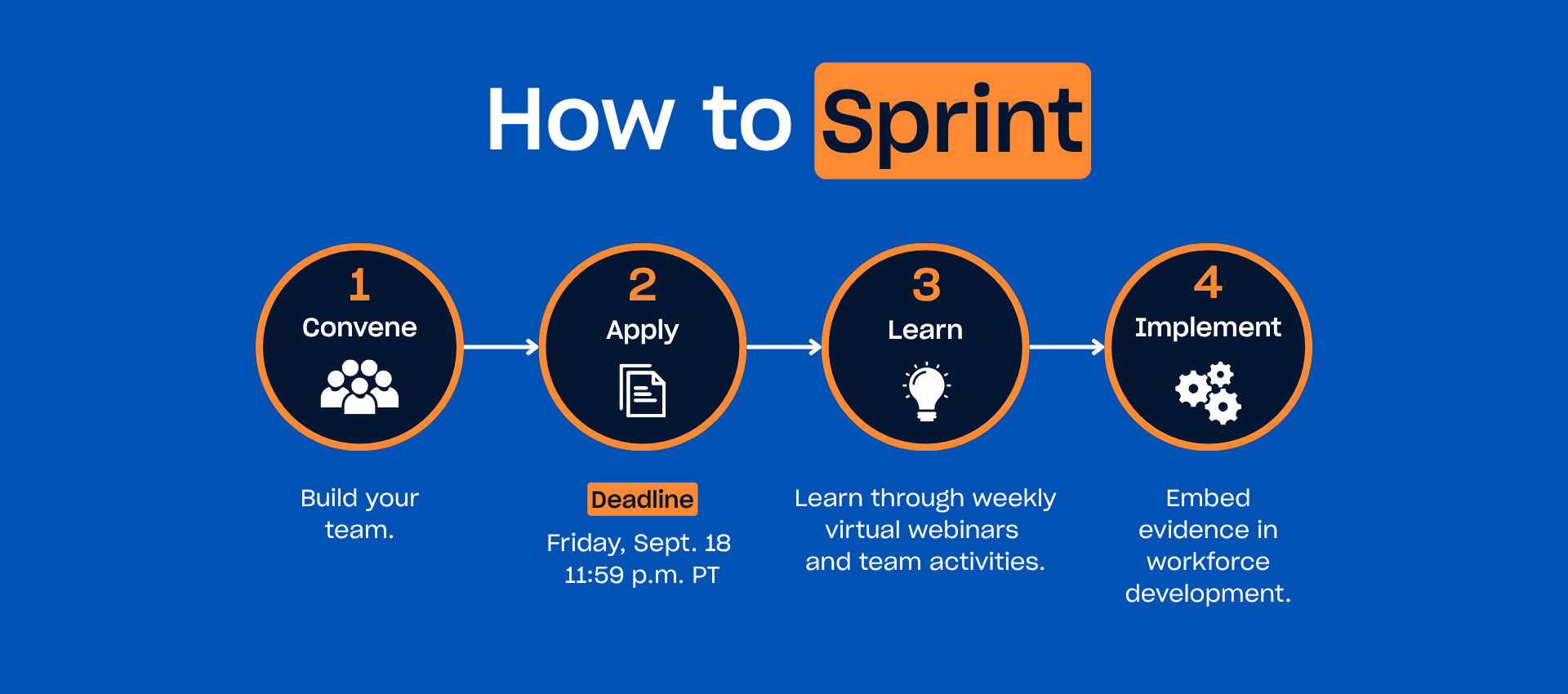
- Application Opens:
Monday, August 17, 2026 - Informational Webinar:
Tuesday, August 25, 2026 at 1 p.m. ET - Application Deadline:
Friday, September 18, 2026 at 11:59 p.m. PT - Pre-Sprint Orientation Session:
Tuesday, September 29, 2026 - Sprint Kickoff: Tuesday, October 6, 2026 at 2 p.m. ET
- Duration of the Sprint: 6 weekly Zoom sessions, (90 mins each)
Time Commitment
The Sprint includes six weekly 90-minute sessions, beginning Tuesday, October 6, 2026 and running through November 10, 2026, from 2-3:30 p.m. ET.
Weekly Time Commitment: Each week, you’ll need to commit to 1.5 hours of guided learning during the sessions, plus an additional 1-2 hours for reading and team work outside of the sessions. We recommend setting aside extra time for team collaboration, discussing session topics, and completing workbook assignments.
Attendance Expectations: To make the most of this Sprint, a majority of the team (3-5 members) must be able to attend each session, though we strongly encourage all members to participate in all six sessions.
What You'll Learn
By the end of the Sprint, you and your team will be able to:
- Define evidence of effectiveness aligned to your workforce goals, labor market needs, target populations, and priority outcomes;
- Develop an evidence framework that reflects agency priorities and goals;
- Embed evidence expectations into workforce funding and policy documents;
- Translate evidence frameworks into proposal evaluation criteria and scoring approaches;
- Communicate evidence expectations effectively to key workforce stakeholders; and
- Apply evidence throughout the procurement and grant management lifecycle to improve workforce outcomes.
What You’ll Walk Away With
By the end of the Sprint, you and your team will have developed or started developing the following:
- A problem statement and outcome goals for a live or planned workforce funding or policy decision.
- A customized evidence framework or evidence criteria.
- Draft language or standards for the team’s selected funding or policy decision.
- A decision tool appropriate to the selected decision, such as a grant or RFP scoring rubric, contract-selection or demonstrated-effectiveness review, ETPL eligibility checklist, or framework for implementing an evidence policy.
- An initial plan for aligning budgets, reporting, performance expectations, and program design with the evidence framework.
- A communication and training approach for respondents and staff evaluating proposals.
- A 90-day implementation plan for applying evidence-informed approaches to live or planned workforce decisions.
After participating in the Sprint, you and your team will be better positioned to:
- Use evidence to make clearer and more consistent workforce development funding, procurement, and provider-selection decisions.
- Direct workforce development dollars toward programs with evidence of effectiveness, while also building evidence for promising or emerging models.
- Apply evidence-based practices in future procurement, grantmaking, policy, and performance-management cycles.
- Improve employment, earnings, retention, advancement, and job quality outcomes for employers and job seekers.
Who Should Apply
The Sprint is designed for state and local teams working on one of three active or planned workforce funding or policy decisions:
- Selecting and funding workforce service or training providers through a grant, RFP, or contract;
- Establishing or revising ETPL initial or continued eligibility criteria; or
- Establishing an agency- or board-wide evidence policy.
Participating organizations may include:
- State workforce agencies and workforce development boards;
- Local workforce agencies, workforce development boards, and One-Stop operators;
- State or local agencies that administer workforce development, education, training, or employment-related grants and contracts, including human services, economic development, transportation, public works, corrections, and education agencies;
- Governor’s, mayor’s, county executive’s, or other executive offices overseeing workforce investments or cross-agency workforce initiatives; and
- Other public sector or cross-agency partnerships responsible for funding, selecting or overseeing workforce programs and training providers.
Participating teams should include staff positioned to shape and implement the selected decision, such as program leaders, procurement or grants staff, policy staff, performance or data staff, and workforce board representatives. Teams may come from a single agency or include cross-sector state, local, and partner organizations working together on a shared workforce decision. Individuals are also welcome to apply for and participate in the Sprint. We encourage teams to include 3-5 individuals and no more than 10.
Not sure if you qualify? Reach out to [email protected] and we can answer any questions you have.
Participation Requirements
- Active Participation: A majority of the team (3-5 members) must be able to fully engage in the Sprint. This includes attending all sessions, engaging in group discussions, communicating with Sprint facilitators, and completing assignments.
- Commitment to achieving the goals of the Sprint, both during and after its completion.
Evidence Examples from Colorado, Pennsylvania & Texas
The Colorado Workforce Development Council and Pennsylvania’s Department of Labor and Industry adopted the following evidence framework as part of RFA’s State and Local Workforce Fellowship:
- Strong Evidence
Two or more rigorous evaluations support the program model. - Moderate Evidence
At least one evaluation report has demonstrated that an intervention or strategy has been tested using a well-designed and well-implemented experimental or quasi-experimental design showing evidence of effectiveness on one or more key workforce outcomes. The evaluations should be conducted by an independent entity external to the organization implementing the intervention. - Preliminary Evidence
At least one evaluation report has demonstrated that an intervention or strategy has been tested using a well-designed and well-implemented pre/post-assessment without a comparison group or a post-assessment comparison between intervention and comparison groups showing evidence of effectiveness on one or more key workforce outcomes. The evaluation may be conducted either internally or externally. - Pre-preliminary Evidence
There is program performance data for the intervention showing improvements for one or more key workforce outputs or outcomes.
The Texas Workforce Commission (TWC) chose to use a wider range of tiers in its framework to include applicants with promising practices or the desire to build evidence of effectiveness through their work. TWC allows providers to receive funding for newer programs if they build evidence of effectiveness over the grant or contract period through improved data collection and evaluation.
- High Evidence
At least two approved rigorous studies must show that the program produces positive and meaningful outcomes, with a high degree of confidence that the outcome is primarily caused by the program. - Moderate Evidence
Program must be supported by an approved rigorous evaluation which finds that the program has a positive and meaningful outcome, with a modest degree of confidence that the outcome is primarily caused by the program. - Performance
Program must provide historical output and outcome data for at least two years, along with assessments and post-program follow-up to demonstrate effectiveness. - Experience
Programs do not perform evaluations of participant success or collect data on the effectiveness of the program. Support for program effectiveness comes from anecdotal success stories or other testimonials. - New
Entirely new programs with no evidence of effectiveness or evaluation data. Applicants must explain why the program will achieve positive measurable outcomes and that there is sufficient capacity to collect data and track outcomes.
The application window is now closed. See other upcoming Sprint opportunities here.
Questions?
Reach out to [email protected].