Why It Matters
Most workforce agencies grapple with more needs in their communities than their individual budgets can support. Supportive services, such as childcare or affordable housing, are often limited or non-existent, reducing the likelihood that job-seekers will have the support required to successfully persist in a training program or have a smooth transition into the workforce. Additionally, many individuals require services from multiple programs and navigating numerous systems can be confusing. Braiding, blending, or sequencing can strengthen collaboration and create a more seamless experience for the individual. Finally, some agencies may choose to explore braiding, blending, or sequencing strategies to diversify and de-risk program finances rather than depending on a single funder or source for a program. If one source goes away, the program may still be able to continue at a reduced budget or while staff seeks alternative funding to cover the shortfall.
The process of connecting various funding streams can be as simple as using Workforce Innovation and Opportunity Act (WIOA) funds in conjunction with a foundation grant to provide additional supportive services workers. It can also be more complex, such as weaving together different federal funding streams that have distinct compliance requirements or leveraging impact investments that require repayment with interest. Myriad options and sources exist, each with their own compliance requirements, level of effort, and efficiency.
Overview
Braiding, blending, and sequencing are three interrelated but slightly different concepts. The difference is usually centered on reporting and compliance. While practitioners might use these terms interchangeably, there is a substantial difference to funders who will expect that their funds be managed in alignment with specific compliance requirements.
Braiding
Braiding uses multiple funding sources to support a project. However, those funds and their uses are tracked individually and their respective compliance requirements, such as eligibility or timeframe, must still be met even though they may differ. Separate tracking is required for most federal funding streams as it allows for greater accountability and transparency. Braiding is mostly commonly used to fill gaps in program delivery, such as paying for stipends from philanthropic funds to complement WIOA-funded training, or paying for additional seats in a training course when demand exceeds the budget.
Key Considerations
- Braiding can be determined before a project is launched or incorporated midstream as additional funding sources are identified. Braiding of funding is often highlighted in proposals as a mechanism to extend the impact of the dollars.
- Braiding takes advantage of existing reporting, delivery, and fund management structures but can also be used as a mechanism to advance collaboration amongst partners.
- Over time, programs that regularly braid may align data collection efforts such as enrollment to reduce the burden to participants. They may also share or integrate data to provide more seamless support.
- Often braiding occurs when two services are being provided simultaneously. “For instance, the Centers for Medicare & Medicaid Service (CMS) has clarified that Ticket to Work Outcome and Milestone payments funded through the Social Security Administration may occur simultaneously with payment for Supported Employment services funded through the Medicaid Waiver program to create a more robust support system for individuals seeking sustained CIE.”
- The use of braided funds is often accompanied by co-enrollment requirements to ensure that the individual receiving services meets the compliance requirements of each funding stream. For example, an individual may be co-enrolled in Supplemental Nutrition Assistance Program (SNAP) or Temporary Assistance for Needy Families (TANF) and WIOA in order to combine supportive services funds with educational support. Alternatively, WIOA and Community Development Block Grant (CDBG) funding may be braided where CDBG provides stipends for youth who meet specific family income thresholds and WIOA provides the career navigation support, for example.
Blending
Blending combines two or more funding sources into a single pot or pool of funds. Subsequent tracking, reporting, or performance analysis is conducted for the pool overall, not for each source. Blending often requires prior approval if public sector dollars will be included in the pot. While blending may require more time up front to navigate compliance considerations, it can serve as a strategic tool which provides dividends such as closer partnership, larger impact, or elimination of overlap or duplication.
Key Considerations
- While blending may provide a more seamless experience to both the implementor (e.g. training provider, community-based organization) and the recipient of the services (e.g. out-of-school youth, new american, returning citizen) the administrator of the blended funds often still needs to manage diverse funder inquiries and reporting requests unless data systems have also been integrated.
- Compliance requirements should be carefully reviewed before blending any federal funding streams with other sources. In all cases, it is best to check with the funder about the requirements for blending the funds before doing so.
- There are a variety of workforce organizations that have created pooled funds, such as the Shift Work Forward and Chicagoland Workforce Funder Alliance, which may include a mix of employers, philanthropies, and other core stakeholders. There are also philanthropy led funds such as the Families and Workers Fund (FWF), ReWork the Bay, and New York City Workforce Funders, that pool resources to tackle an issue, population need, or geography.
- The term “pooling” may also be used when federal and state dollars are combined to advance work such as that done through State Children’s Health Insurance Program (SCHIP), which is a partnership that provides health insurance coverage to low-income children. In that example, federal funds are combined with state contributions to expand health insurance access.
Sequencing
Sequencing combines different funding sources by deploying the funds in a specific order to best serve the individual. This is often because eligibility is dependent on timing or conditions. An individual might “age out” of one program and into another or be required to have specific documentation to demonstrate eligibility for one program that can be gained through support in another. For example, an undocumented immigrant youth might participate in WIOA Title II to receive training while working to resolve documentation status and then enroll in WIOA Title I once eligible. Alternatively, an individual experiencing homelessness might first receive support to obtain stable housing and then enroll in WIOA to pursue education and employment. With effective sequencing, each intervention can help address a set of barriers, allowing the individual to continue along their path with minimal interruptions to service delivery.
Alternatively, sequencing can be driven by compliance or operational needs rather than programmatic needs such as the expenditure timelines, “use or lose” funding, carryover provisions, and even delays in funding disbursement. For example, an agency might use philanthropic funding first to cover costs while waiting for the second disbursement of WIOA youth funding to ensure there are no interruptions in service due to cash flow.
Partnership Structure for Funding
As agencies make decisions about whether and how to leverage additional sources of funding, they may also consider they type of legal entity fit for purpose for the type of funding being used. This analysis is generally driven by whether the benefits of a model exceed the cost of additional logistics or expenses.
Sample entities include non-profit Public-Private Partnerships (PPPs), pooled funds, joint power agreements (JPA), and separate 501(c)(3) entities. For example, NevadaWorks uses a joint powers agreement that weaves together multiple counties to deliver services for the local area. Similarly, New York City established a separate nonprofit entity called the Workforce Development Corporation (WDC), a collaboration across multiple partners, to implement their new green jobs strategy.
Federal
Engaging with a diversity of partners can expand opportunities to deepen a program’s impact through braiding or sequencing of funding. PDF
Employer
The employers who benefit from workforce programs can also provide sources of funding that can be considered for blending, braiding, or sequencing. PDF
Investors
Impact capital, social impact bonds, and other private sector investments are another potential source of braided funds. PDF
Common Approaches
Each of these three funding models – blending, braiding, and sequencing – can be used to maximize the impact of a program. The level of effort can vary greatly depending on the existing depth of relationships and flexibility of infrastructure.
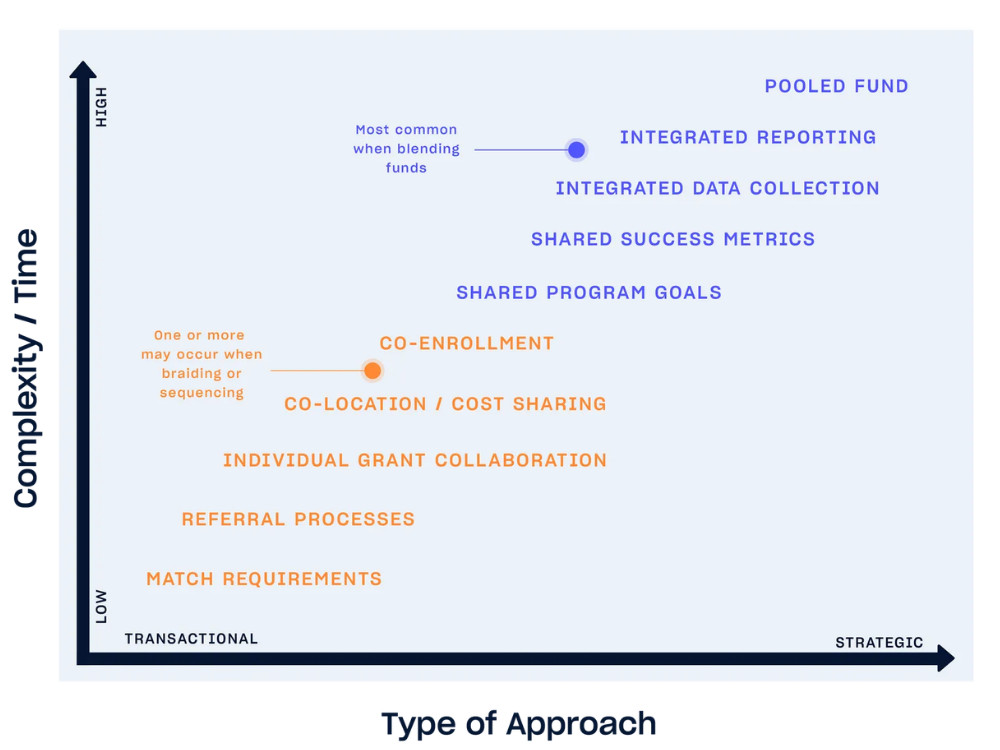
Download: Common Approaches for Implementation – Table 1
Download: Benefits and Challenges of Braiding, Blending and Sequencing Funding
Note: Another important consideration as agencies blend, braid, or sequence funding, is the impact that the provision of one type of support may have on the individual’s access to another. For example, depending on how stipends are structured, they could be treated as income and thus put a worker’s access to childcare vouchers in jeopardy. Or, using on-the-job (OJT) funds to increase a worker’s wage during training might increase their job quality but also trigger loss of benefits due to income thresholds. The Federal Reserve Bank of Atlanta’s Career Ladder Identifier and Financial Forecaster (CLIFF) is a helpful tool to better understand the complexities inherent in public assistance programs. The Office of Human Services Policy also issued a helpful guide for navigating benefits cliffs and their impacts.
Embedding Equity in the Work
- Personas and User Journeys: When designing new programs with sequenced or braided funding consider using personas and user journeys not only to center the needs of the participant in the design but virtually walk through the process to surface potential inconsistencies or areas of confusion due to differences in eligibility across funding streams, reporting requirements, and hand-offs. Consider where there may be flexibility to better integrate processes in ways that still collect necessary data for compliance with funding requirements but feel more seamless to the individual.
- Consider Existing and Future Data: Use the conversations around blending, braiding or sequencing as an opportunity to examine where existing (or future) data sets might provide additional insights into the population being served. For example, will the number of people served increase thus providing a larger sample size and better facilitating data disaggregation? Will new funding allow for the collection of qualitative data to complement existing quantitative data?
Note: For more information on diversifying funding streams you can also check out the Opportunity for Change from the Job Quality Playbook called Diversifying Revenue Streams.
Leading Examples
Government Leading Practices
- Deleware leverages a combination of federal, state, institutional and private funding streams for career development through the Delaware Pathways program. The program is charged with supporting youth and adult learners to achieve Delaware’s postsecondary attainment goals.
- In Cuyahoga County, the Ohio Department of Job and Family Services is piloting a program to braid WIOA and SNAP E+T services through the local Ohio Means Jobs network in order to provide targeted advancement pathways to SNAP enrolled participants.
- The Governor’s Office of Education and Workforce Development (GOEWT) in Alabama was established to implement a coordinated workforce and education strategic plan. One of the office’s three main objectives is to “braid Alabama’s federal education and workforce development funding streams to support an education-to-workforce pipeline.”
- In support of their integrated planning processes, Wisconsin’s Departments of Health Services, Workforce Development and Public Instruction put together a Transition Action Guide (TAG) which helps their state and local governments identify overlaps or gaps in service provision in the areas of communication, coordination and service delivery for youth. The guide “includes funding sources and their eligibility requirements so agencies can pursue braided funding opportunities. The resource also discusses cost-sharing agreements among agencies and when these agreements are appropriate.”
- The California Workforce Development Board (CWDB), California Department of Corrections, and the California Prison Industry Authority (CalPIA) developed a joint strategic plan which “links education, job training, and work experience in prison to post-release jobs by fostering a system of coordinated service delivery to a population that faces a variety of barriers. It serves as a blueprint for building local and regional partnerships to improve labor market outcomes and reduce recidivism.” The agencies then combined funding, through the Prison to Employment Initiative, to allow local workforce areas to implement programming for justice involved individuals. Local boards follow a single reporting process when providing results to the state.
Non Profit Leading Practices
- The United Way of Greater Atlanta established Atlanta CareerRise as a separate 501c3 that is leading the way on workforce development. Through CareerRise, Atlanta is leaning in on apprenticeship programs in non traditional spaces, such as healthcare, for opportunity youth. CareerRise takes an industry partnership-focused model which braids and blends funding from workforce, education and philanthropy to provide the necessary education, job assistance and supportive services to the community.
- The Advanced Manufacturing Apprenticeships is a non profit which offers adult and youth apprenticeship programs across Washington, Oregon and Idaho. “In 2020–21, AJAC drew on 24 unique funding streams to support its operations and programs. Of these, 19 were from federal, state, or local sources and ranged in size from $10,000 grants from municipal partners to million-dollar grants from state and federal agencies. The remaining five sources (12 percent of all funding) came from private sources, including philanthropic grants, fees paid by employers, or student-funded tuition costs. AJAC has become adept at braiding these resources to make its funding work.”
Employer Leading Examples
- Guild Career Opportunity Platform works with employers including Walmart, Taco Bell, and Discover to provide employer-funded learning programs, dedicated career coaches, and tools to explore career pathways. Employees can choose to pursue degrees or shorter skills programs. All costs are paid for by their employer and the Guild supports logistics and learners’ experience to increase success and return on investment.
- The American Diesel Training Center’s Career Impact Bond is “the first Career Impact Bond where certain employers, like Interstate NationaLease, Palmer Kenworth and National Fleet Management, will take over monthly tuition payments for the graduates that they hire.” While many other Career Impact Bonds require that students or participants repay tuition and other costs of their training, this is an example of shifting those costs to the employer.
Additional Resources
- Case Studies for the Google Career Certificates Fund and New Jersey Pay It Forward Program by Social Finance
- “Unraveling the Finance Models of Work-Based Learning Intermediaries” by New America Foundation
- “Braided and Adaptive Funding” by Jobs for the Future
- “Co-Invest for Impact” by National Fund for Workforce Solutions
- “Blended and Braided Funding” by Urban Institute
- “Leveraging Americorps Programs as a Workforce Development Strategy in Your Community” by Americorps
- “Blending and Braiding Resources to Support the Employment of People with Disabilities” by the National Technical Assistance and Research Center to Promote Leadership for Increasing the Employment and Economic Independence of Adults with Disabilities
- “Yes, WIOA Can! Effectively Leveraging or Braiding Multiple Funding Sources with WIOA” by Workforce GPS
- “Budgeting to Promote Social Objectives – A primer on braiding and blending” by Brookings
- “Guide for Competitive Integrated Employment and Blending, Braiding, and Sequencing Resources” by the Department of Labor
- Case Study using braiding for Substance Use Disorder services by the Center for Financing Reform and Innovation
- SNAP E+T and Workforce Boards by the National Association of Workforce Boards (NAWB)
- Improving Transition Services for Youth and Young Adults with Disabilities through Braided Funding by the Center for Advancing Policy on Employment for Youth
Evidence Base for Braiding, Blending or Sequencing Funding
The research on workforce funding models has grown over the years as federal dollars have fluctuated and new models have been explored. Some examples of existing studies include:
- Models for CHW Sustainability & Workforce Development (see info on study of City Colleges of Chicago) by Paige Menking
- Using Braided Funding Strategies to Advance Employer Hiring Initiatives that Include People with Disabilities by Robert Nicholas, Ronnie Kauder, and Kathy Krepcio
- Financing Workforce Development in a Devolutionary Era by Stuart Andreason, the Federal Reserve Bank of Atlanta, and the University of Pennsylvania
- Four Promising Practices from a Workforce Development Partnership by Steve Myran, Paul Sylvester, Mitchell R. Williams & Gunder Myran
- Improving Collaboration between Welfare and Workforce Development Agencies by Nanette Relave
Compliance Considerations
While braiding, blending, and sequencing can be powerful models to meet an individual’s needs, there are important compliance requirements that users of these techniques should keep in mind. For example, below are summaries for key workforce-related areas:
Download: Compliance Considerations – Table 1
Each of these funding models – blending, braiding and sequencing – should be used in a way that is fit for purpose. The timeline and expected duration of a program, degree of partnership, and funder requirements will all influence which model is most appropriate for a given scenario. See some examples below of when a particular model might be most applicable. In all cases, compliance requirements should be closely reviewed before any one of these approaches is implemented.
Download: Compliance Considerations – Blending, Braiding, Sequencing
Getting Started
How to Get Started
- For new programs, document the desired impact of the program and then assess:
- Which funding source or sources would be best positioned to support the work?
- How might those sources be used in tandem?
- Is this a short-term operational need or a long-term strategic opportunity?
- For programs that are already up and running, perform a gap assessment. Be specific about the amount and characteristics of the funding needed.
- Examine your current funding sources as well as those of your partners. Consider:
- Could the total costs of the program be divided up amongst various sources through cost allocation?
- Could the costs for certain aspects (such as training, transportation, food) be paid from one source vs another based on their areas of focus?
- Could the funding be sequenced in a way that would expedite the delivery of service, reduce risk or increase participation?
- Consider which funding sources might be missing.
- Is your current “capital stack” primarily made up of the public sector? Exclusively philanthropic? How might you engage with new funders to raise awareness of this work? Beware the myth of diversification – diverse sources of funds can be powerful but sometimes they are just more work. Depends on the amount, timing, requirements, etc.
- Conduct exploratory conversations with potential stakeholders/funders to assess feasibility of partnership for the project.
- Carefully evaluate the compliance requirements associated with each funding source.
- Is it allowable to use the funding to cover the gap?
- What is the level of effort and is it worth it based on the expected benefit?
- Do you have the human resources necessary to tackle it?
- Review your existing processes to determine what other changes might be necessary to provide a seamless customer experience.
- Will changes be needed to forms to meet all eligibility or compliance requirements?
- Could data or staff be shared across partners to avoid having a participant re-tell their story?
- Could teams be co-located or cross trained?
- Can systems be connected or integrated to speed up access to information?
- What governance processes or structures will be needed to successfully manage the partnership?
- Rank target funding sources based on factors such as complexity, stakeholder interest and capacity, etc.
- Prioritize sources of funding, acknowledging that an agency may choose a more modest budget with fewer sources of funding as compared to a larger budget with more – and more complicated – sources of funding.
- Establish systems and processes to support successful implementation of the project such as:
- Program strategy (e.g. leadership councils, shared strategy documents, program meetings)
- Governance (e.g. committee, task force)
- Operations (e.g. cross-training, referral processes, co-location options, risk management, staff engagement and training)
- Data and Reporting (e.g. enrollment forms, monthly or quarterly performance metrics, fiscal reporting)
- Evaluation and Continuous Process Improvement (e.g. interviews, focus groups, 3rd party evaluator engagement)
- Fund and operate the program, tracking funds and activities appropriately.
- Monitor and adjust as needed throughout the life of the program.